
Workshop with Future Pathways, Scotland
Workshop 1 was held in May 2023 in Perth, Scotland, in collaboration with the charity Future Pathways. We discussed in detail the specific needs of those who would attend the workshops, and planned a 2-day event that encompassed poetry reading (and writing), flash fiction, and life writing. The poetry workshop was the first session, and most attendees took to it well, with only a few attendees reluctant to speak, to comment on what they had read, or to write some lines of verse. It struck me, as facilitator of the workshop, that looking at poetry - and, specifically, at sonnets - gave the session a structure around which discussions could arise - discussions about a whole host of things that weren't limited to poetry. Some attendees linked poetry quite closely with lyrics, which took some unpacking - it suggested that with people whose educations have been interrupted, often for reasons outside of their control, 'poetry' might be linked more to snippets heard over the radio, or via music, than through formal educational channels. I chose a Scottish poem by Edwin Morgan, a sonnet titled 'The Coin' from Morgan's Sonnets from Scotland, as a poem that might spark interest. Attendees were very interested in the questions the poem raised about the idea of a 'future' Scottish republic, and how Morgan might have envisaged this in 1984.
Our Life Writing tutor, Jane McVeigh, had this to add about her session: "The last session explored how to approach writing a life story. It included taught material on writing skills and attendees were given a handout. Some of them were already writing about their own traumatic experiences or hoped to do so in future. An early discussion considered how to write about traumatic events and details that the writer may not want to share. An acknowledgement that life stories are written for all sorts of reasons raised questions about who they are written for, and why. For those attendees who were hoping to publish their story, exploring how to approach writing about a particular scene or person illustrated the significance of show not tell. In other words, the extent to which an example can illustrate a relationship or experience without the need for extensive explanation. We talked about a range of other aspects of writing a life story, such as the extent to which writing is both solitary and collaborative. Talking to other people can help to fill the gaps in a life story, although some interviews can be difficult and painful. Also, how can language help us to describe events that are unspeakable. I hope attendees were inspired to carry on with their writing and to look for other opportunities and courses to develop their skills."
Our Flash Fiction tutor, Terri Mullholland, noted: "Overall, I found the experience to be a rewarding one. Most of the group did not have previous experience at critically analysing a piece of writing and it was impressive to hear such insightful comments from members of the group on the language and structure of the poems and flash fiction pieces we read together, including ways to improve one of the pieces of flash fiction by rewriting it from a different narrative perspective. I was particularly encouraged that so many of the attendees engaged enthusiastically with the writing exercises and were keen to share their work with the wider group. A key learning for me was the benefit of providing a guided prompt that started the writing off, a line for them to complete or a word to include, rather than asking them to write more generally on a topic. It demonstrated how everyone can write something if given the right guidance and hopefully some of the group will go on to develop the pieces they started as there was some striking imagery and wordplay."
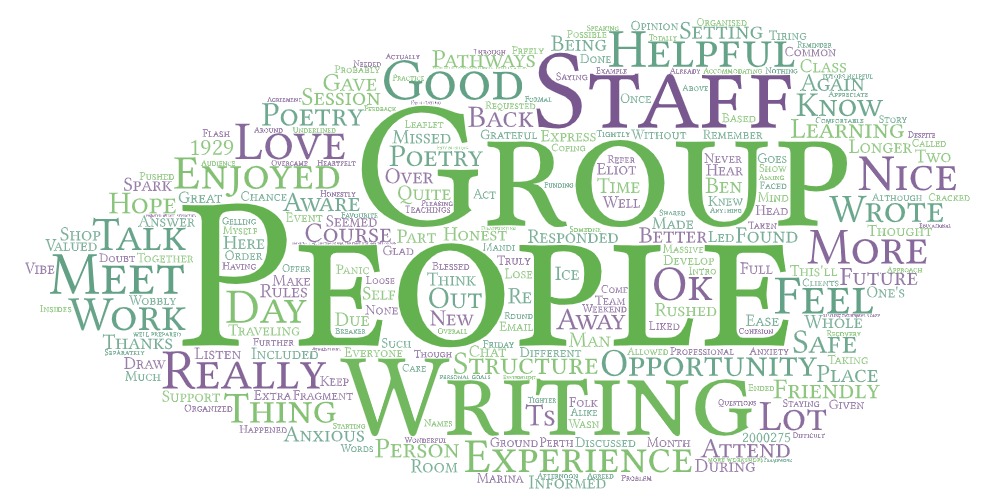
A word cloud generated by the attendees at the workshop